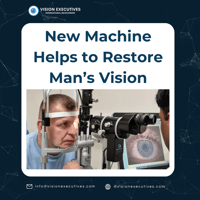
𝐍𝐞𝐰 𝐌𝐚𝐜𝐡𝐢𝐧𝐞 𝐇𝐞𝐥𝐩𝐬 𝐭𝐨 𝐑𝐞𝐬𝐭𝐨𝐫𝐞 𝐌𝐚𝐧’𝐬 𝐕𝐢𝐬𝐢𝐨𝐧 👨⚕️ Surgeons at...
For someone living with severe vision loss, the possibility of seeing more of the world around them carries enormous meaning. It is this human ambition that makes the 2026 Nobel Prize in Physiology or Medicine particularly relevant to ophthalmology.
Karl Disseroth, Peter Hegemann, and Georg Nagel have been recognised for discoveries behind optogenetics, a technique that allows scientists to use light to activate selected cells. Their work has applications across neuroscience, including research into restoring some vision lost to retinal disease.
For the eyecare community, the award is an opportunity to celebrate the science behind a hopeful question: could surviving cells in the eye help people see again?
What is optogenetics?
Optogenetics gives the selected cells the ability to respond to light.
Its foundations came from research into light-sensitive proteins found in algae. Scientists discovered how these proteins could be used to make other cells respond to light, opening new possibilities for studying the nervous system.
In ophthalmology, researchers are exploring how this principle could help when disease has damaged the cells that normally detect light. The aim is to make other surviving cells in the retina light-sensitive, potentially allowing them to take on part of that function.
Why does this matter for retinal disease?
The retina is the light-sensitive tissue at the back of the eye. It contains specialised cells, called photoreceptors, that help the start of the process of seeing.
Conditions such as retinitis pigmentosa can progressively destroy these cells and cause severe sight loss. Optogenetic research explores whether cells that remain could provide another route to useful vision.
An early human study has demonstrated why this possibility has attracted attention. Researchers used an injection to deliver genetic instructions that made selected retinal cells sensitive to light, alongside specially designed goggles that directed light signals onto those cells, helping a damaged eye respond to visual information again.
An early milestone in restoring visual function.
In 2021, a study published in Nature Medicine reported partial recovery of visual function in one patient who was blind due to retinitis pigmentosa.
Using the treated eye while wearing the specialist goggles, the patient could perceive, locate, count, and touch objects during tests. The reported benefit depended on the combined treatment and goggles; the patient could not detect objects with the treated eye alone without them.
This was the result in one patient, rather than evidence of a treatment that would work for everyone. Nevertheless, it provided an important demonstration that an optogenetic approach could produce some useful visual function in a person with advanced retinal disease.
What could progress mean for patients?
The value of vision research ultimately lies in what it might make possible in everyday life.
For someone with severe sight loss, even a limited improvement could potentially make certain tasks easier. Being better able to locate an object or understand the space immediately around them could matter deeply.
These possibilities also help explain why research outcomes need to be considered carefully. An improvement measured during a controlled assessment is one step; understanding how reliably it helps someone in daily life is another.
The questions that matter to patients are practical: how much could it help, how long might the benefit last, and what would treatment and rehabilitation involve?
What does the Nobel recognition mean for ophthalmology?
The award recognises fundamental discoveries that have opened new directions for research. It should not be read as confirmation that sight-restoring optogenetic treatments are ready for routine use.
For ophthalmology, its significance is the recognition of science that could expand what future care can achieve. It also highlights the long journey from a laboratory discovery to research involving patients.
Moving that forward requires collaboration between scientists, ophthalmologists, clinical research teams, and patients. Each contributes to understanding whether a promising approach can become a safe, reliable, and meaningful treatment.
Stay connected with Vision Executives.
Follow Vision Executives on LinkedIn to stay up to date with the latest eye care industry news, insights and job vacancies across ophthalmology, optometry, optical retail and medical technology.