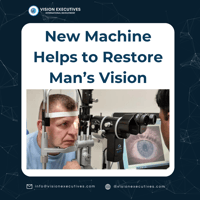
𝐍𝐞𝐰 𝐌𝐚𝐜𝐡𝐢𝐧𝐞 𝐇𝐞𝐥𝐩𝐬 𝐭𝐨 𝐑𝐞𝐬𝐭𝐨𝐫𝐞 𝐌𝐚𝐧’𝐬 𝐕𝐢𝐬𝐢𝐨𝐧 👨⚕️ Surgeons at...
Beyond the eye chart: Personalised LASIK after cataract surgery.
For some patients, a good result on the eye chart does not fully reflect how they experience their vision after cataract surgery. Glare, halos or difficulty seeing clearly in dim lighting can leave them feeling disappointed, even when surgery has gone well.
Research presented at the American Academy of Ophthalmology's annual meeting explores whether raytracing-guided LASIK could help this gap.
How does raytracing-guided LASIK work?
Raytracing models how light travels through the whole eye to calculate a personalised laser correction.
The researchers suggest that a subtle difference in the alignment of an implanted intraocular lens may contribute to optical distortions. Assessing the eye as a complete optical system could help guide treatment for selected patients with persistent visual complaints.
What did the study find?
Led by Dr A. John Kanellopoulous, the study evaluated 55 eyes with implanted intraocular lenses, using Alcon's WaveLight Plus platform.
At 3 months, researchers reported:
- Approximately 70% fewer higher-order abberations, the complex optical distortions that can affect visual quality.
- Improved unaided distance vision, from an average of 20/23 to 20/16.
- Reduced astigmatism, from -0.85 D to -0.25 D.
- Better contrast sensitivity in dim lighting.
Encouraging results, with further research needed.
The investigators suggest this approach could offer an alternative to lens exchange for appropriately selected patients. However, using the platform in eyes with lens implants is off-label.
The findings cover a small series with 3 months of follow-up. Longer-term research, direct comparisions with conventional laser enhancement and validated patient questionnairs are planned. The results should therefore be viewed as promsing early evidence.
Keeping the patient's experience in focus.
For ophthalmic teams, the research highlights the importance of exploring visual concerns beyond standard acuity measurements.
Future patient-reported outcomes will help establish whether the measured improvements translate into a more satisfying everyday visual experience. Alongside advances in diagnostic and treatment technology, listening carefully to patients remains central to understanding what a successful outcome means to them.
Stay connected with Vision Executives.
Follow Vision Executives on LinkedIn to stay up to date with the latest eye care industry news, insights and job vacancies across ophthalmology, optometry, optical retail and medical technology.